The Architecture of Uprising
Abstract
This paper investigates the structural and psychological mechanisms by which dominant systems maintain power over the marginalized — through propaganda, engineered economic constraint, and the suppression of critical consciousness — and charts a rigorous, actionable course of resistance for those who are awake, under-resourced, and ready to move.
Drawing upon critical consciousness theory (Freire, 1970), hegemony studies (Gramsci, 1971), feminist political economy (Mies, 1986; Federici, 2004), gift economy thought (Hyde, 1983; Eisler, 1987), propaganda analysis (Herman & Chomsky, 1988), and emergent strategy (brown, 2017), this paper synthesizes a comprehensive diagnostic of the current global condition alongside a seven-pillar praxis framework.
The audience is explicitly the awake and awakening: those living at the margins of economic, social, and epistemic power who possess limited material resources but immense relational, spiritual, and cognitive capacity.
The paper argues that liberation is not merely possible but structurally inevitable when marginalized people (a) correctly identify the mechanisms of their oppression, (b) cultivate sovereign consciousness, (c) organize in fractal and decentralized networks, and (d) build parallel economies grounded in reciprocity and care.
Application steps throughout are designed to be zero-cost or near-zero-cost, executable in community settings, and scalable without institutional permission.
Keywords: critical consciousness, propaganda, gift economy, marginalization, liberatory praxis, emergent strategy, hegemony, collective efficacy, epistemic sovereignty
I. Introduction: The World as It Is
The Architecture Of Uprising
We begin not with an abstraction but with a body. A tired body. A body that has worked too many hours for too little return, that has navigated bureaucratic systems designed to exhaust rather than assist, that carries in its nervous system the accumulated weight of being surveilled, sorted, and found wanting.
This paper is written for that body — and for the mind behind those eyes that, despite everything, still sees clearly.
The dominant narrative of the early twenty-first century insists that the suffering of marginalized people is a personal failure: of discipline, of intelligence, of work ethic, of moral character.
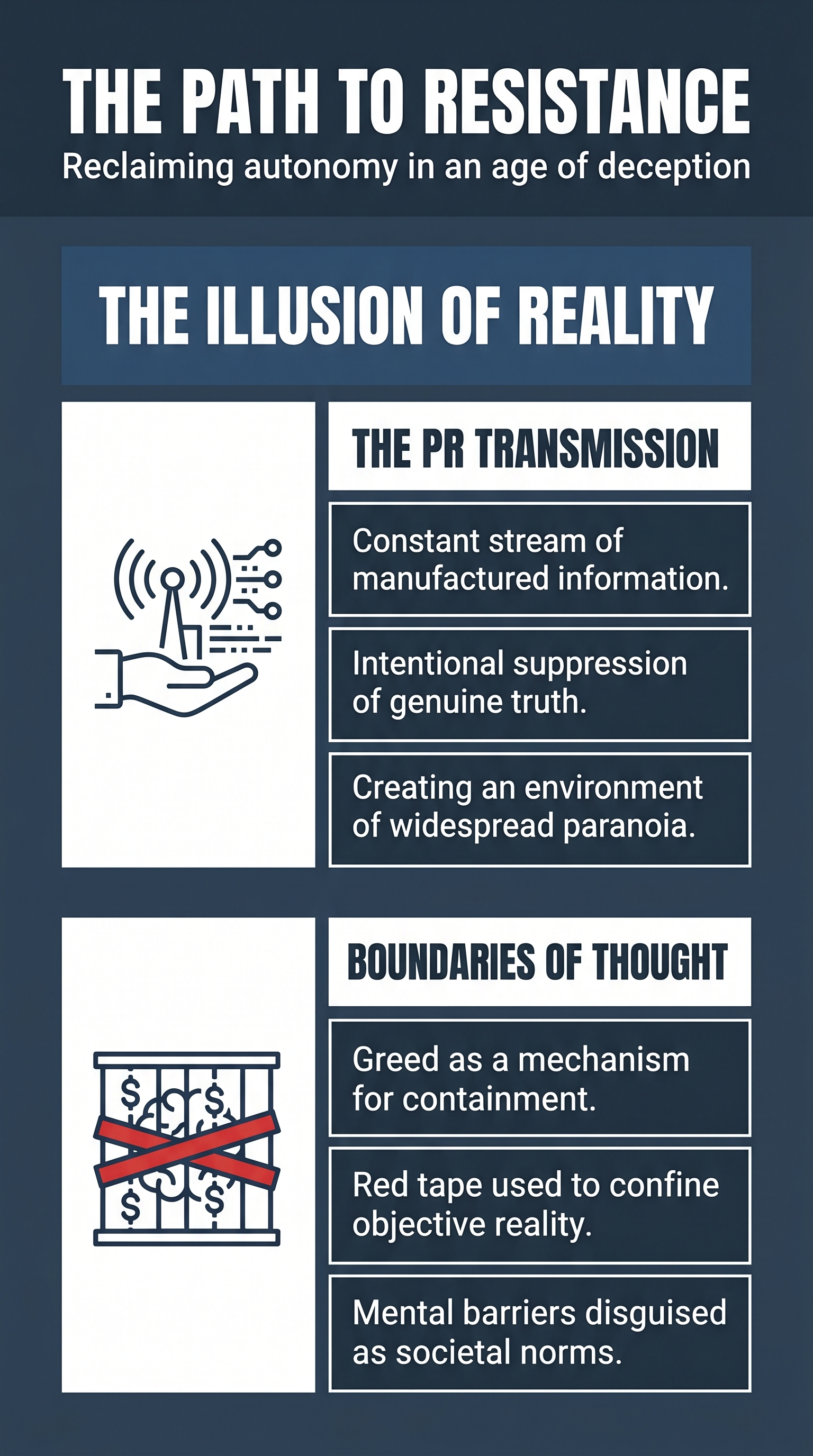
This narrative is not accidental. It is manufactured — systematically, expensively, and with sophisticated precision — to prevent those most harmed by current arrangements from correctly identifying the source of that harm.
When people cannot name what is oppressing them, they cannot organize against it. That is the design.
Yet something is shifting.
Across demographics, geographies, and ideological backgrounds, a growing segment of the global population is awakening — not simply to political discontent, but to a deeper epistemic clarity.
They are beginning to see the architecture: the way information flows are curated, the way economic rules are selectively enforced, the way psychological manipulation operates through platforms, institutions, and even intimate relationships.
They are awake enough to be dangerous to the status quo, yet frequently under-resourced enough to feel paralyzed.
This paper is written for those people. It is simultaneously a diagnostic of what is happening in the world right now, a theoretical map of why it is happening, and — critically — a prescriptive manual of what to do about it with the resources actually available to people living at the margins.
The analysis proceeds through seven thematic pillars: (1) propaganda and manufactured paranoia, (2) greed as cognitive and structural imprisonment, (3) the praxis of defiance and dignified refusal, (4) awakening consciousness as revolutionary prerequisite, (5) revolution as cyclical and structurally inevitable, (6) unity and decentralized collective power, and (7) the teleology of liberation — victory not as hope, but as historical pattern.
Each section closes with a concrete praxis protocol designed for those with more will than wallet.
II. Propaganda and the Manufacturing of Paranoia
2.1 The Propaganda Model in the Digital Age
The Architecture Of Uprising
Herman and Chomsky's (1988) propaganda model identified five filters through which mass media systematically serve elite interests: ownership concentration, advertising revenue dependency, reliance on official sources, the threat of flak, and ideological framing.
Published decades before social media, the model has proven extraordinarily prescient — and in the digital age, its mechanisms have been turbocharged.
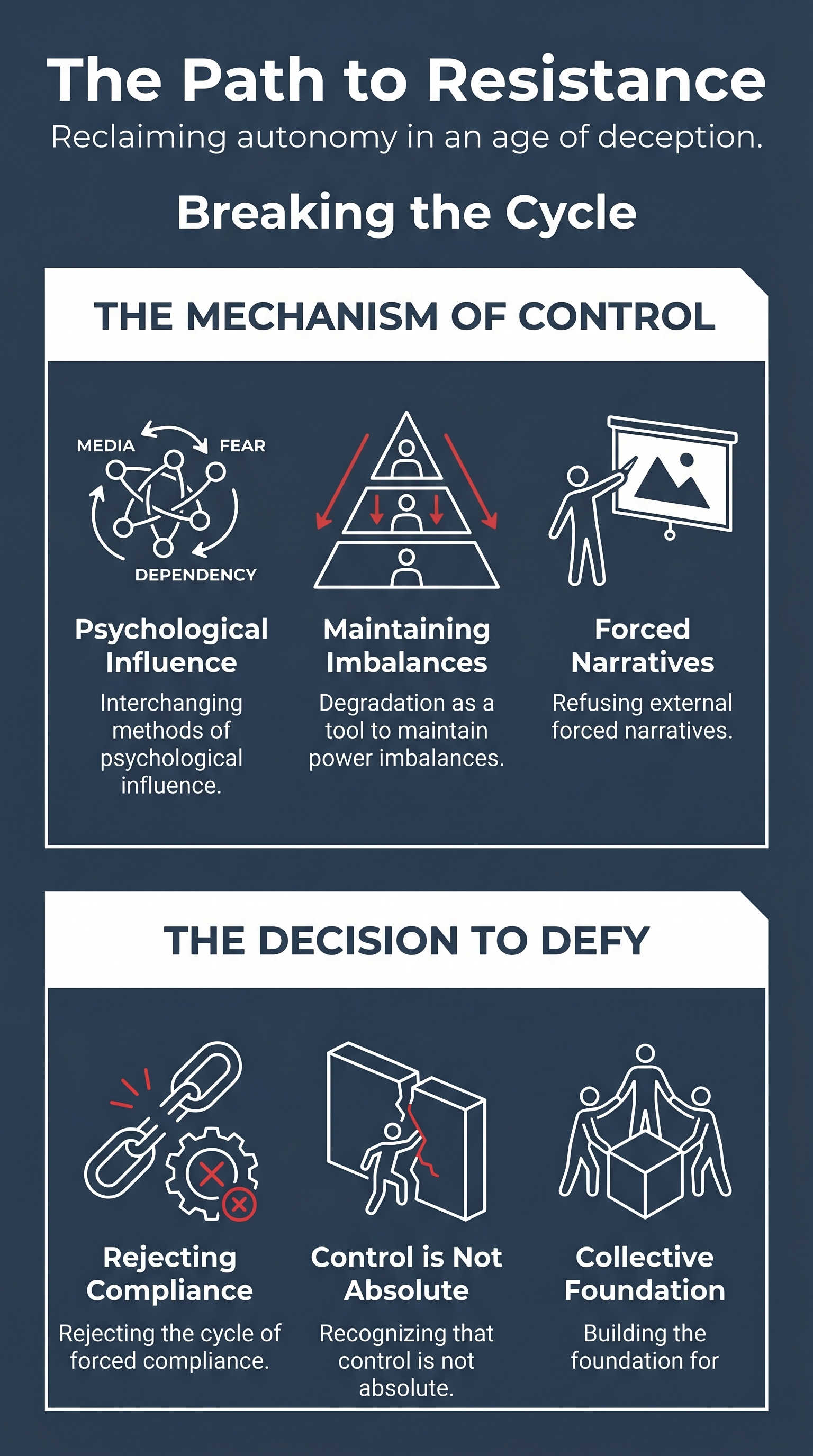
Algorithmic content curation does not merely filter information; it actively engineers affective states.
Platforms designed around engagement metrics have systematically discovered that outrage, fear, and paranoid vigilance drive higher interaction than nuance, complexity, or joy (Orlowski, 2020).
The result is a population marinating in low-grade threat perception — not the clarifying kind that motivates action, but the diffuse, demoralizing kind that fragments attention, undermines trust, and renders collective organizing nearly impossible.
This is the "paranoia in bloom" the poet-diagnostician names: not the awakened vigilance of the discerning mind, but the manufactured anxiety of the surveilled subject.
Bernays (1928), the architect of modern public relations, was explicit that mass psychology could be weaponized to manufacture consent for arrangements that served narrow interests. His insight has become industry standard operating procedure.
"The conscious and intelligent manipulation of the organized habits and opinions of the masses is an important element in democratic society... Those who manipulate this unseen mechanism of society constitute an invisible government which is the true ruling power of our country." — Edward Bernays, Propaganda (1928, p. 9)
What Bernays could not have anticipated was the participatory dimension of digital propaganda: people are now not merely recipients of manufactured narratives but active distributors of them.
The platform economy has made ordinary users into vectors of elite messaging, rewarding resharing of polarizing content with social currency while penalizing careful, sourced, nuanced communication. The architecture of social media is, in the precise technical sense, a manipulation engine.
2.2 Psychological Dimensions: Paranoia as Control Technology
The Architecture Of Uprising
Beyond media analysis, the manufacturing of paranoia operates at the level of embodied psychology. Porges's (2011) polyvagal theory describes how the autonomic nervous system shifts between states of safety, mobilization (fight/flight), and shutdown (freeze/dissociation) in response to perceived threat cues.
Chronic exposure to threatening information — even when mediated through a screen — trains the nervous system into a persistent threat-detection mode that impairs the higher cognitive functions necessary for clear political analysis, long-term planning, and collective trust.
This is not metaphor. It is neurobiology in the service of social control.
A population locked in sympathetic nervous system overdrive cannot think strategically, cannot sustain the trust necessary for coalition building, and is maximally susceptible to scapegoating narratives that redirect legitimate grievance toward other marginalized groups rather than toward structural causes.
This is the propagandist's masterwork.
PRAXIS PROTOCOL I — Media Sovereignty and Nervous System Defense
- Conduct a media audit. For one week, document every information source you consume, the emotional state it produces, and whether it provides actionable understanding or merely heightened arousal. Discard what produces heat without light.
- Establish a "propaganda immune system" practice. Before consuming any news or social media, spend three to five minutes in a grounding practice — slow exhale breathing (4-count inhale, 6-count exhale), bilateral tapping, or physical movement — to anchor your nervous system in a regulated state where critical analysis is neurologically possible.
- Source upstream. Train yourself to ask of every narrative: who benefits from my believing this? Who funded the institution that produced it? Who is not being quoted? What question is this story preventing me from asking?
- Curate toward clarity, not volume. Identify three to five trusted analysts or journalists whose methodology you have vetted. Go narrow and deep rather than broad and shallow. The information diet of the liberated mind is curated, not scrolled.
- Practice narrative inoculation in community. Gather with others — a kitchen table works — and practice identifying propaganda techniques together: false equivalence, manufactured urgency, scapegoating, appeal to inevitability. Name the technique out loud. The named thing loses power over the nervous system.
III. Greed as Cognitive and Structural Prison
3.1 The Green Belt Thesis: Financialization as Mind Control
The Architecture Of Uprising
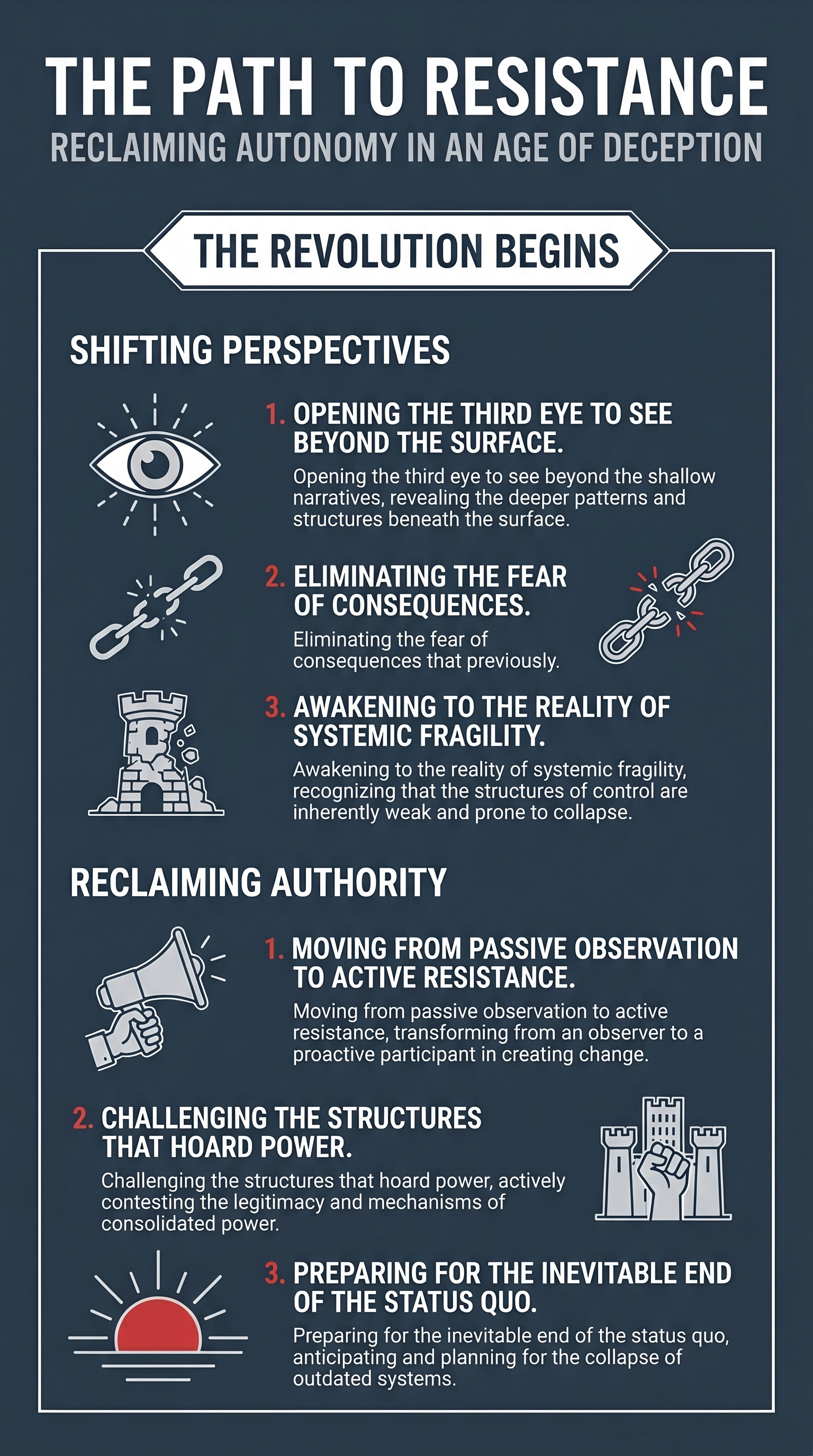
The metaphor of "green belts wrapped around our minds" captures something that economic sociology has documented with increasing precision: the financialization of everyday life is not merely an economic condition but a cognitive and ontological one.
When rent, healthcare, education, and water are monetized — when every human need becomes a market — consciousness itself becomes colonized by scarcity calculus.
People whose material survival is perpetually precarious cannot think beyond the immediate. This is not a personal failure; it is a predictable outcome of structural design.
Mullainathan and Shafir (2013) demonstrated experimentally that scarcity — regardless of its domain — captures cognitive bandwidth in ways that measurably reduce IQ-equivalent performance.
Poverty does not merely deprive people of material goods; it taxes the cognitive resources required for strategic planning, impulse regulation, and long-term thinking.
This "cognitive tax" is a structural feature of the current economic arrangement, not a side effect.
A population cognitively depleted by scarcity is a population that cannot organize effectively against the conditions producing that scarcity.
Federici (2004), building on Marxist feminist analysis, extends this argument: the unpaid care economy — disproportionately borne by women and feminized subjects — represents an enormous extraction of human energy and time that is systematically rendered invisible in economic accounting.
The "green belts" are not only material; they are temporal. Those who spend the greatest portion of their lives in survival labor — wage labor plus care labor — have the least time for the political consciousness work that resistance requires.
3.2 Bourdieu's Capital Taxonomy and the Trap of Meritocracy
The Architecture Of Uprising
Bourdieu (1986) articulated how power reproduces itself across generations not only through economic capital (money, property) but through cultural capital (credentials, speech patterns, aesthetic sensibilities) and social capital (network access, institutional belonging).
The meritocratic myth — that the system is open and rewards individual talent — functions precisely to obscure this multi-dimensional reproduction of advantage, attributing systemic outcomes to individual virtue or failure.
For marginalized people, this means that even when economic capital is scarce, cultural and social capital can be cultivated as genuine sources of power.
The community elder who has navigated thirty years of systemic bureaucracy possesses extraordinary strategic knowledge.
The neighborhood organizer who knows everyone's name holds social capital that no bank account can purchase.
The person who has survived what would break others carries a form of wisdom that elite institutions cannot replicate. Recognizing and naming these forms of wealth is a first act of liberation.
PRAXIS PROTOCOL II — Mapping and Mobilizing Non-Monetary Capital
The Architecture Of Uprising
- Conduct a community wealth audit. Map the non-monetary assets in your immediate network: skills, relationships, knowledge, tools, space, time. Most communities are far wealthier than they appear on any economic measure. Make the wealth visible.
- Build a skills exchange. Even informally — a text thread, a whiteboard at a community space, a weekly gathering — create mechanisms for people to offer and request skills without money changing hands. This is not charity; it is the infrastructure of a parallel economy.
- Time banking. Explore established time banking platforms and practices (TimeBanks USA; Timebanking UK). In time banking, one hour of service equals one hour of credit, regardless of what service is performed. A massage is worth the same as legal advice. This structurally encodes the matriarchal insight that all forms of human labor carry equal dignity.
- Reclaim your cognitive bandwidth. Identify one financially-driven anxiety spiral you engage in regularly. Practice interrupting it with the question: "What can I do about this in the next 24 hours?" If the answer is nothing, consciously redirect cognitive resources toward something actionable. This is not denial; it is tactical attention management.
- Study the gift economy. Hyde's The Gift (1983) and Eisler's The Chalice and the Blade (1987) are foundational texts available in most public library systems at no cost. Understanding that market logic is historically recent and culturally specific — not universal or natural — is a profound cognitive liberation.
IV. The Praxis of Defiance and Dignified Refusal
4.1 Fanon, hooks, and the Ontology of the Oppressed
The Architecture Of Uprising
Fanon (1963) argued that colonized people internalize the colonizer's gaze — coming to see themselves through the categories of degradation their oppressors impose.
This internalization is not weakness; it is a survival adaptation in an environment where the dominant definition of reality is backed by violence.
But the liberation project requires its undoing. The first revolution is always internal: the refusal to accept the oppressor's definition of your worth, your capacity, your future.
bell hooks (1994, 2000) framed this as the move from margin to center — not the assimilation into dominant culture that liberal multiculturalism often imagines, but the recognition of the margin itself as a site of radical possibility.
Those who have survived at the edges of a system know that system in ways that those at the center cannot.
The margin is not merely a place of deprivation; it is a place of epistemological advantage.
The awake and awakening poor understand capitalism's contradictions in their bodies.
This knowledge is revolutionary.
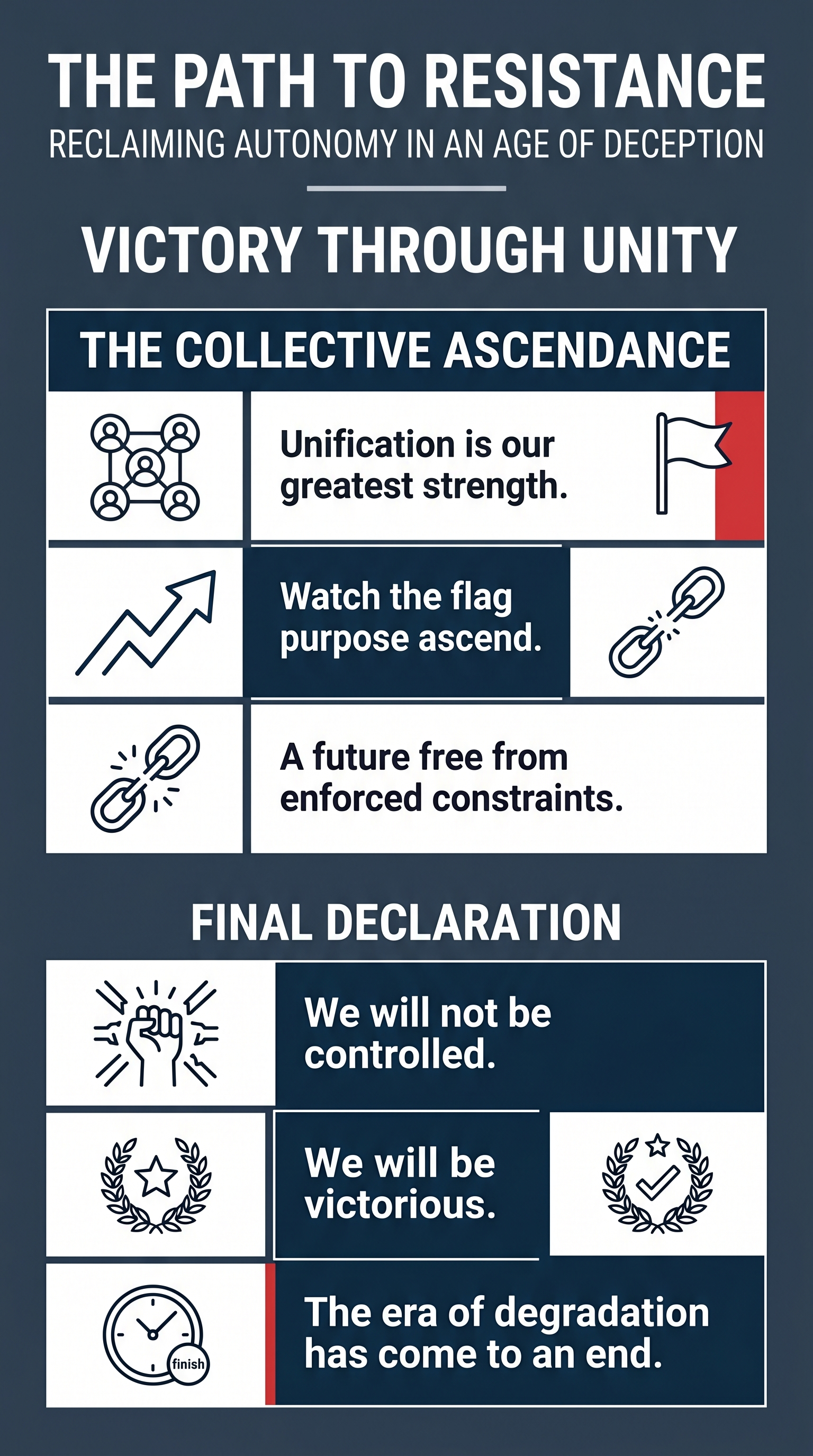
The declaration "they will not force us, they will stop degrading us, they will not control us" is not merely emotional expression.
It is a speech act of ontological sovereignty — a claim of the right to define one's own reality, made in direct confrontation with systems that deny that right.
Freire (1970) identified this naming as the foundational act of humanization: "To exist, humanly, is to name the world, to change it" (p. 88).
The oppressed who speak their condition aloud — who name the mechanism, name the harm, name their own dignity — have already begun the revolution.
4.2 The Strategic Value of Dignified Non-Compliance
The Architecture Of Uprising
Sharp (1973), in his monumental study of nonviolent resistance, catalogued 198 methods of nonviolent action, organized across three categories: protest and persuasion, noncooperation, and nonviolent intervention.
His central insight — that power is not inherent in rulers but is granted by the compliance of the governed — reframes powerlessness as strategic leverage. When enough people withdraw consent from a system, the system cannot function.
This does not require dramatic confrontation, which often carries asymmetric risk for marginalized people.
It can be as quiet as refusing to participate in narratives that shame the poor, as targeted as choosing to spend whatever dollars are available at locally-owned businesses, as intimate as refusing to pass inherited shame on to one's children.
Every act of dignified non-compliance is a structural contribution to systemic erosion.
PRAXIS PROTOCOL III — Dignified Refusal in Everyday Life
V. Awakening Consciousness as Revolutionary Prerequisite
5.1 Conscientização: Freire's Dialectic of Liberation
Freire's (1970) concept of conscientização — critical consciousness — describes the process by which oppressed people move from a naive, fatalistic acceptance of their situation ("this is just how things are") to a critical understanding of the structural causes of their condition and their capacity to transform it.
This is not an intellectual exercise; it is a transformative practice, enacted through dialogue, reflection, and action in iterative cycles Freire called "praxis."
The metaphor of "opening the third eye" in the musical text maps precisely onto this tradition: not as mystification, but as the development of a form of perception that can see through the surface of things to their structural underpinnings.
The "third eye" is critical consciousness — the capacity to see that what presents itself as natural, inevitable, or divinely ordained is in fact historically constructed, politically maintained, and therefore changeable.
Freire was emphatic that this awakening cannot be delivered to people by experts or saviors.
It must be cultivated dialogically — in community, through encounter with lived experience, through the reciprocal sharing of what each person knows.
This is why liberation traditions consistently center the conversation over the lecture, the circle over the stage, the question over the answer.
These are not merely aesthetic preferences; they are epistemological commitments rooted in a theory of how consciousness actually transforms.
5.2 Indigenous and Matriarchal Epistemologies as Decolonial Tools
The matriarchal and gift economy traditions that Oracles of Matriarchy amplifies carry within them epistemological frameworks fundamentally at odds with the dominant worldview — and therefore fundamentally liberatory.
Where dominant epistemology privileges abstraction, individualism, competition, and the extraction of value from context, matriarchal knowing privileges embodied knowledge, relational intelligence, cyclical thinking, and the regeneration of collective wealth.
Eisler's (1987) partnership model contrasts "dominator" social organizations — hierarchical, violence-backed, extractive — with "partnership" models characterized by mutual respect, shared decision-making, and the honoring of life-giving over death-dealing.
Her cross-cultural and archaeological analysis suggests that partnership arrangements are not utopian fantasy but historical reality — repeatedly suppressed, but never extinguished.
The "third eye" that sees this history cannot un-see it.
PRAXIS PROTOCOL IV — Cultivating Critical Consciousness
VI. Revolution as Cyclical and Structurally Inevitable
6.1 Gramsci's Hegemony and Its Structural Contradictions
Gramsci (1971) observed that dominant power maintains itself not primarily through force but through hegemony — the production of consent by making the existing order appear natural, universal, and common-sensical.
The ruling class rules not just through the state but through culture, education, religion, and media, encoding its interests into the very categories through which people understand their world.
But Gramsci also identified hegemony's structural vulnerability: it requires ongoing active maintenance.
It is never complete, never stable, never perfectly reproduced. Counter-hegemonic movements — what Gramsci called "organic intellectuals" of the working class — continuously erode its foundations by proposing alternative common senses that better account for the lived experience of those whom the dominant order marginalizes.
The measure of a counter-hegemonic moment is not its dramatic visibility but its quiet spread through the practical consciousness of ordinary people.
The sociologist Wallerstein (2004) argued that the modern world-system — capitalism as a global structure — is in a period of terminal crisis, characterized by simultaneous crises of accumulation, legitimacy, and ecological sustainability that cannot be resolved within the existing framework.
The question is not whether transformation is coming, but what shape it will take — and who will have had the foresight to organize toward the alternatives they want.
6.2 Reading the Current Moment
By multiple structural indicators, the current period represents exactly the kind of hegemonic crisis Gramsci and Wallerstein describe.
Wealth concentration has reached levels not seen since the Gilded Age, with documented erosion of the material conditions that historically produced middle-class stability and political moderation (Piketty, 2014).
Institutional trust — in government, media, science, religion, finance — has collapsed across the ideological spectrum.
Climate disruption is producing resource pressures that will intensify existing inequalities geometrically.
And artificial intelligence is restructuring labor markets in ways that threaten to displace the economic foundation of the working and middle classes simultaneously.
These are not abstract trends but the conditions in which the tired, awake, under-resourced people this paper addresses are living.
They represent simultaneously the worst of times and — in the Gramscian sense — a genuine "organic crisis" in which the old order is dying and the new has not yet been born.
What fills that interregnum is determined by who organizes most clearly and most lovingly toward what they want.