Ep 095 Local And Ancient Futures
In Ep 095 Local And Ancient Futures, Helena Norberg-Hodge, a renowned expert in localization and sustainable living, shares her extensive 50-year journey working to promote local futures and resist the global monoculture driven by corporate interests.
She began as a linguist fascinated by different worldviews before moving to Ladakh, a remote Himalayan region, where she witnessed a vibrant, healthy, and interconnected society rooted in Tibetan Buddhist culture and localized economies.
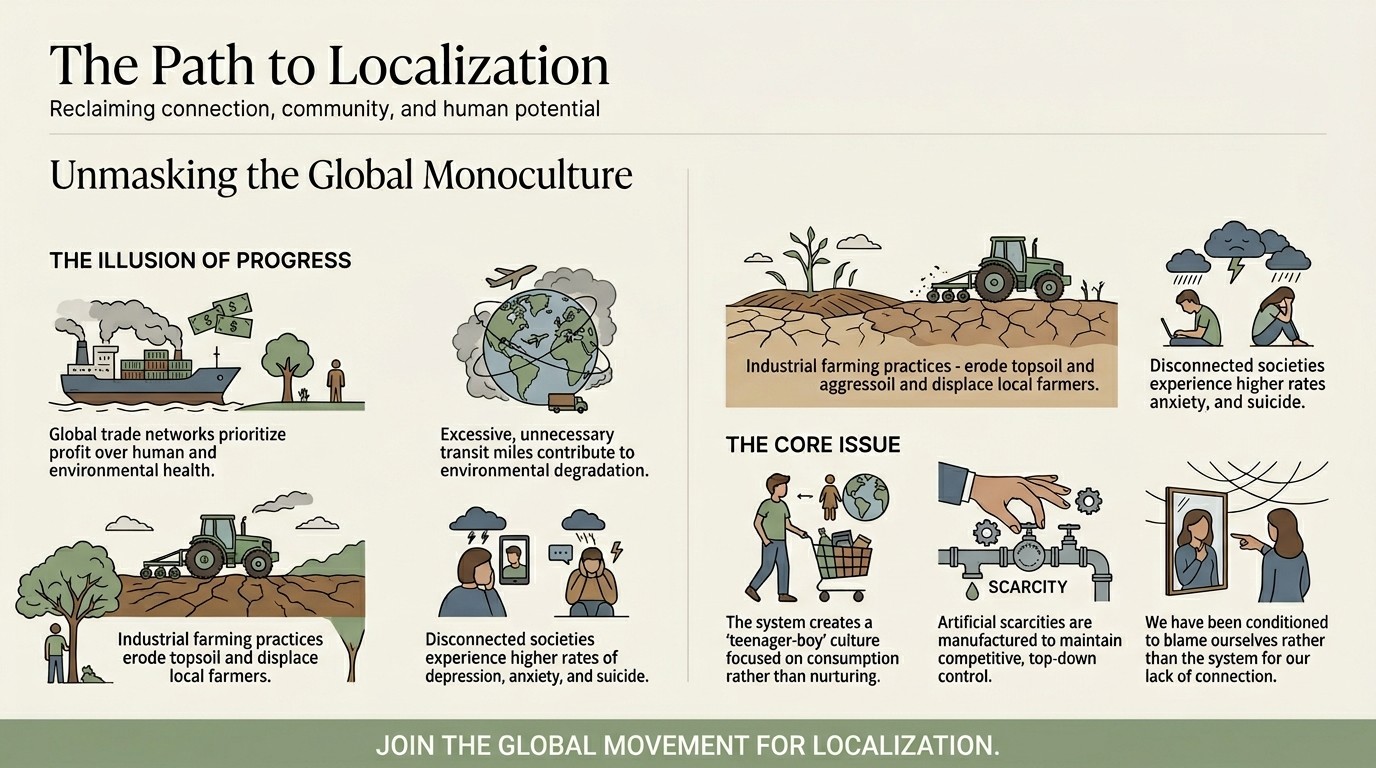
Helena contrasts this with the destructive effects of global monoculture, which promotes monocropping, corporate control over seeds and food systems, and a disconnection from nature, resulting in environmental degradation and widespread mental health crises.
Her work emphasizes decentralization, reconnecting people with land, community, and intergenerational knowledge, and fostering diversified local economies rather than reliance on global supply chains and monoculture agriculture.
She highlights the growing international localization movement, which includes initiatives like transition towns, permaculture, eco-villages, and local food movements, celebrating the power of hyperlocal living combined with global communication through decentralized, open-source technologies.
Helena warns that despite signs of systemic breakdown, the global industrial monoculture remains robust and supported by governments and corporations, often using misleading language like "regenerative agriculture" to mask harmful practices.
The Path to Localization
Ep 095 Local And Ancient Futures
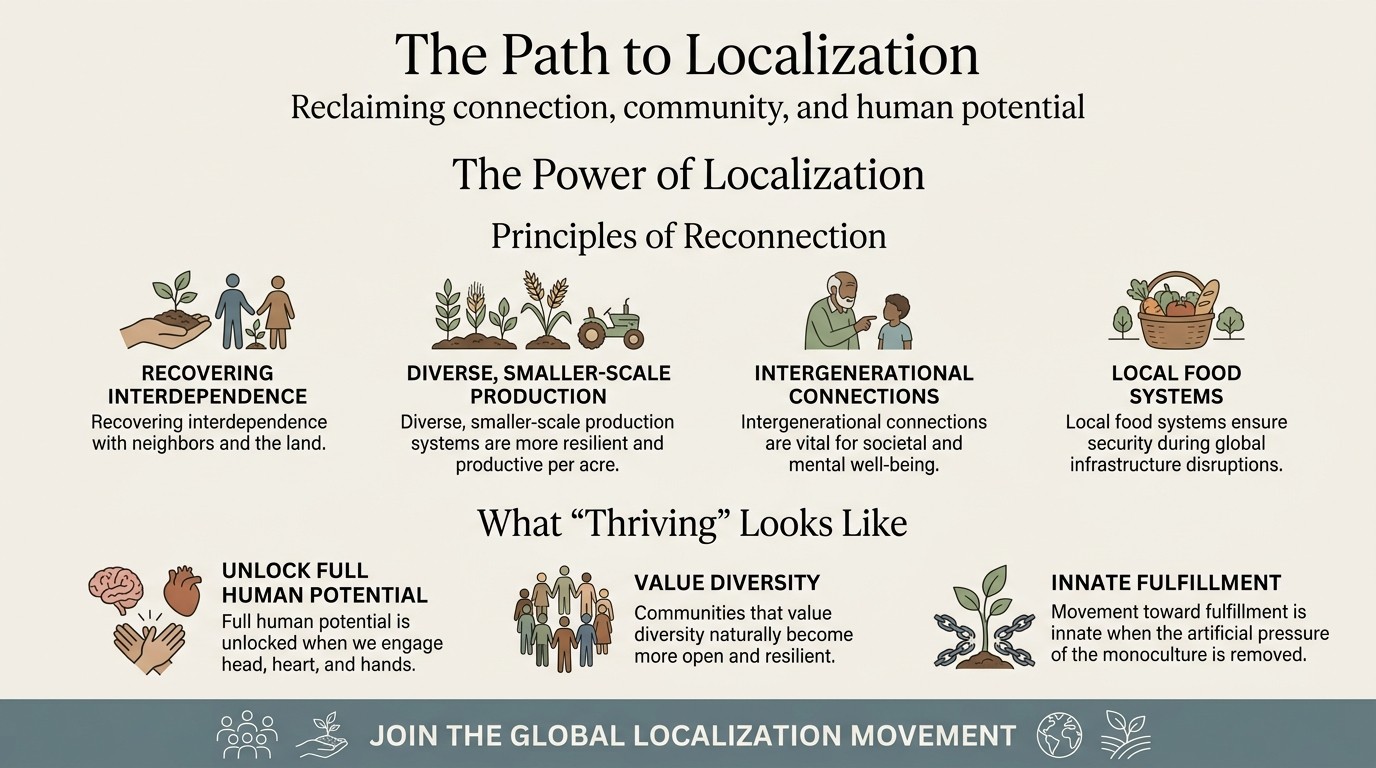
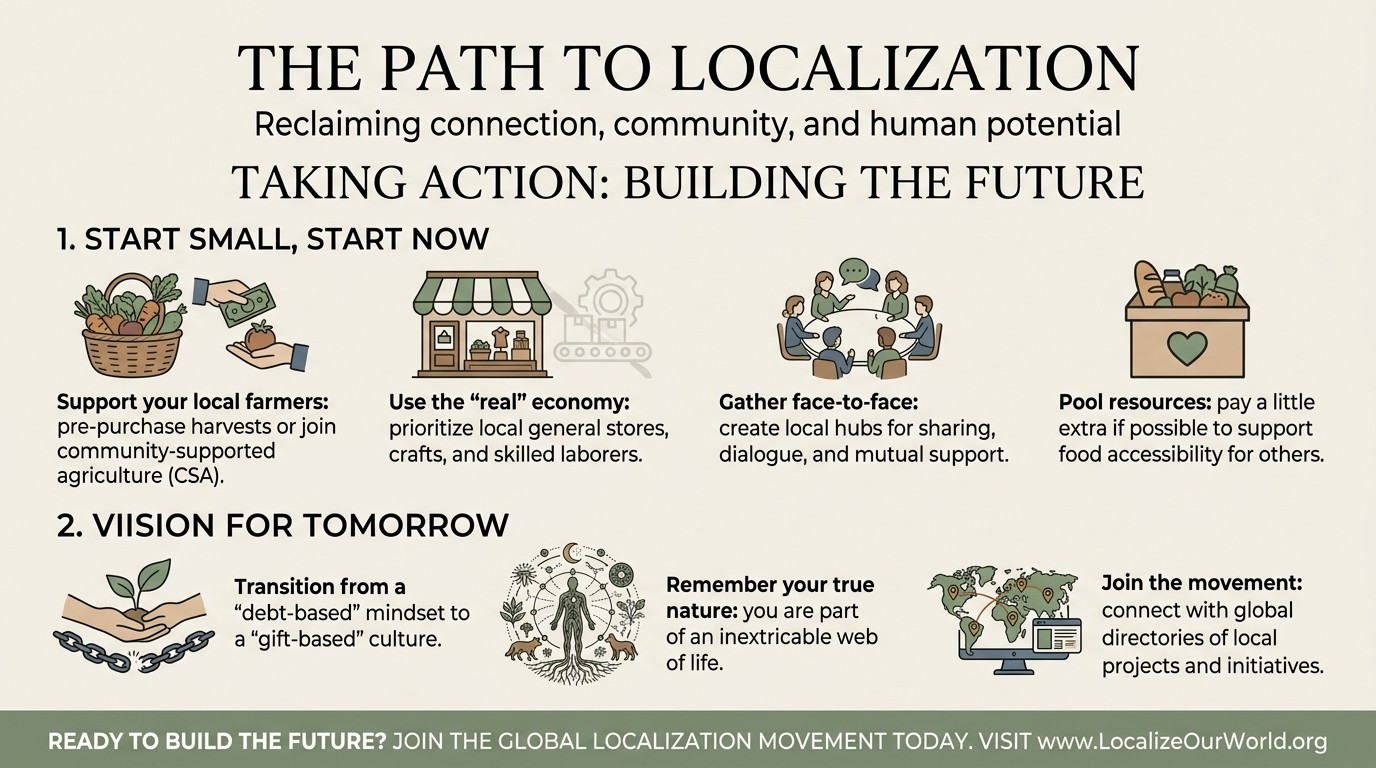
She advocates for practical steps to support local food systems using existing national currencies, fostering community interdependence, and preparing for a future that integrates gift economies and local currencies while maintaining connection to the broader global network.
Throughout the conversation in Ep 095 Local And Ancient Futures, Helena stresses the importance of holistic healing—both mental and physical—which she sees as intrinsically linked to deep connections with community, nature, and a nurturing feminine principle that has been suppressed by patriarchal, consumerist systems.
She critiques modern psychology and corporate-driven narratives around mental health, urging a paradigm shift toward recognizing that disconnection from natural systems, not individual pathology, underpins widespread social and health problems.
Finally, Helena calls for embracing oneness and interdependence, reclaiming indigenous wisdom and decentralized living, and fostering face-to-face, heartfelt communication as foundational for cultural and ecological regeneration.
She encourages spreading awareness widely, building resilient local networks, and rejecting the dominant system’s fear-based narratives, emphasizing that thriving is possible through community, diversity, and reconnection with nature.
Highlights/Key Insights/Additional Observations for Ep 095 Local and Ancient Futures
- 🌍 Helena Norberg-Hodge’s 50 years of work focus on resisting global monoculture by promoting localization and hyperlocal living.
- 🏔️ Her transformative experience in Ladakh revealed a thriving, healthy society deeply connected to land, community, and Tibetan Buddhist values.
- 🌱 The global monoculture leads to environmental harm, mental health crises, and loss of diversity, driven by corporate control and monocropping.
- 🤝 Localization movements worldwide include transition towns, permaculture, eco-villages, and local food initiatives that rebuild decentralized economies.
- 💡 Decentralized, open-source technologies combined with local economies present a way to balance global connectivity and local resilience.
- ❤️ Mental and physical health depend on deep community and nature connections, and healing requires reclaiming feminine, nurturing values.
- 💬 Face-to-face communication and community building are essential to overcoming fear, fostering courage, and enabling systemic change.
- 🌏 Global monoculture is unsustainable and destructive: Helena’s observations from Ladakh to Sweden reveal how globalized industrial systems devastate local economies, biodiversity, and human well-being. The dominate corporate-driven model prioritizes profit over ecological and social health, leading to monoculture farming, pesticide reliance, mental health decline, and loss of cultural diversity. This monoculture is propped up by governments through trade agreements favoring corporations, underscoring systemic capture and control.
- 🌿 Localization fosters resilience and abundance: Decentralized, diversified local economies reconnect people with land, nature, and each other. Helena emphasizes that localized food systems not only produce fresher, healthier food but also rebuild biodiversity and soil health by avoiding monoculture. The localization movement, encompassing varied grassroots initiatives, demonstrates that thriving economies do not require global monoculture or high-tech industrialization but rather community-based, regenerative practices.
- 🧠 Mental health crises stem from systemic disconnection, not individual pathology: Helena critiques mainstream psychology and mental health frameworks for ignoring the root cause—alienation from nature, community, and meaningful work. She argues that mental disorders are symptoms of living "inside a machine" rather than organically. Healing and well-being arise through deep connections, multi-skilled living, and nurturing environments that restore both individuality and interdependence, as seen in traditional societies.
- 👩🌾 Feminine principles and decentralized leadership are essential for regeneration: The suppression of feminine values—nurturing, caring, relationality—by patriarchal and industrial systems has contributed to ecological and social breakdown. Helena highlights how Tibetan Buddhist and indigenous cultures historically elevated the feminine and how modern movements must reclaim these values for sustainable futures. Decentralized, community-led structures empower women’s oral communication and leadership, critical for social cohesion and ecological management.
- 🔄 Technology can support but must not replace local culture: The internet and decentralized peer-to-peer technologies offer unprecedented potential to connect local communities globally without replicating extractive systems. Helena and her interlocutor discuss visions of open-source, non-extractive networks that serve people rather than corporations, enabling the sharing of knowledge, resources, and cultural exchange while maintaining local autonomy and ecological balance.
- 💰 Transitioning economies require pragmatic strategies and awareness-raising: Attempts at gift economies or local currencies have often failed due to fear and attachment to national currency systems. Helena advises using existing currency systems to build local interdependence by supporting local farmers and businesses, creating advance purchase agreements, and fostering farmers markets to rebuild social cohesion. This pragmatic approach lays groundwork for eventual shifts to alternative monetary systems like giftcoin, which prioritize abundance and reciprocity over debt and extraction.
- 🌐 Global crises require embracing oneness and interdependence, not divisive narratives: The dominant narrative of collapse and competition fuels fear, fragmentation, and hopelessness. Helena advocates a worldview rooted in interconnection and oneness, drawing on indigenous wisdom and spiritual traditions that emphasize the unity of all life. This perspective enables courage, creativity, and collective action, countering the isolation and alienation imposed by modern consumer culture and capitalist systems.
- Helena stresses the importance of intergenerational knowledge transmission and community-based child-rearing practices that nurture individuality within a collective framework.
- She critiques "carbon colonialism" and corporate co-option of environmental language, urging vigilance against greenwashing efforts that mask ongoing ecological destruction.
- The conversation highlights the urgency of food security as foundational to community resilience, particularly in times of crises such as pandemics and climate disasters.
- Helena’s life experience spanning Western and indigenous cultures uniquely positions her to bridge global-local dynamics and articulate a hopeful, practical path forward.
- Emphasis on multi-skilled, polymathic human development contrasts sharply with modern specialization and alienation from nature and community.
- The discussion includes a nuanced critique of spirituality’s role, acknowledging both its power for healing and the risks of co-optation by global monoculture narratives.
This rich dialogue in Ep 095 Local and Ancient Futures provides a comprehensive and hopeful blueprint for building sustainable, healthy, and joyful futures rooted in local empowerment and global solidarity.