Ep 030 | The Kindreds: Our Six Human Subspecies
An Integrative Framework for Archetypal Human Diversity
Overview
Ep 030 | The Kindreds: Our Six Human Subspecies presents an imaginative yet structured framework for understanding human variation through six archetypal “Kindreds”: Fairies, Elves, Hobbits, Gnomes, Dwarves, and Humans.
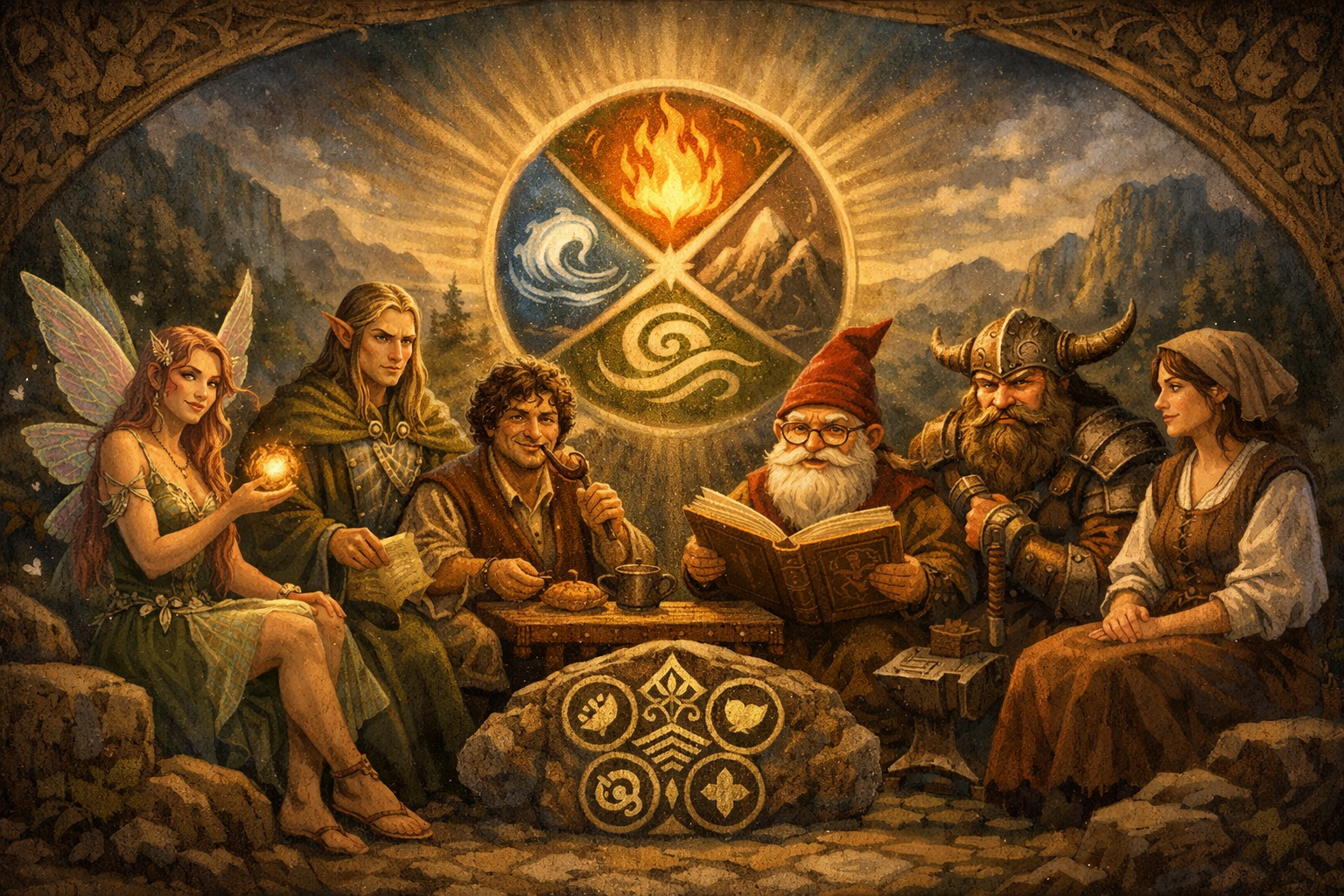
Rather than proposing literal biological subspecies (no, no one is about to sprout wings mid-meeting), this model functions as a symbolic and phenomenological taxonomy—a way of describing consistent patterns in temperament, cognition, embodiment, and social behavior using the language of elemental archetypes.
At its core, the Kindreds framework integrates insights from somatic awareness, archetypal psychology, systems thinking, and elemental symbolism, offering a multidimensional lens for understanding how individuals differ—and more importantly, how those differences can become complementary rather than conflicting.
Each Kindred is associated with a pairing of the classical elements—air, water, earth, and fire—which together form a kind of energetic “operating system.”
These elemental combinations are used to describe tendencies in movement, emotional tone, relational style, and modes of contribution.
In plain terms: some people are here to dream, some to build, some to organize, some to research, some to protect, and some to keep the whole system from flying off the rails.
All are necessary.
Yes, even the one who color-codes the spreadsheet.
Conceptual Foundations
1. Archetypal Structuring of Human Behavior
The Kindreds model aligns with established traditions in archetypal
theory, where recurring patterns of human experience are organized into
symbolic forms.
These archetypes are not prescriptive identities but descriptive patterns—fluid, overlapping, and responsive to context.
2. Embodiment as Epistemology
A key premise of the framework is that knowledge is not solely cognitive but somatically mediated.
That is, the body is not just along for the ride—it is actively informing perception, decision-making, and relational dynamics.
Translation: your nervous system knows things your overthinking brain is still drafting a memo about.
3. Elemental Symbolism as a Mapping Tool
The use of air, water, earth, and fire provides a non-pathologizing language for describing differences in energy and behavior.
Rather than labeling traits as “too much” or “not enough,” the model reframes them as expressions of elemental balance.
So instead of “you’re difficult,” it becomes “you might be running a little high on fire today.”
Which, frankly, lands better.
4. Systems-Based Interdependence
The Kindreds are best understood as components within a complex adaptive system.
Each archetype fulfills a distinct role that contributes to the resilience and functionality of the whole.
Or put more simply: if everyone is a visionary, nothing gets built.
If everyone is a builder, no one knows what they’re building.
Balance matters.
The Six Kindreds (Briefly, Before Anyone Forms a Committee)
- Fairies — Catalysts of play, creativity, and lateral thinking. High adaptability, low tolerance for boredom. Likely to improve your idea and then wander off mid-conversation.
- Elves — Strategic visionaries and long-range thinkers. Oriented toward coherence, systems, and execution at scale. The ones who actually read the entire plan.
- Hobbits — Grounded, relational, and heart-centered builders. They bring warmth, stability, and continuity. If something feels like home, a Hobbit probably touched it.
- Gnomes — Deep researchers, analysts, and integrators of complex knowledge. They connect dots you didn’t even know were on the same page.
- Dwarves — Practical implementers, protectors, and makers. Action-oriented, resilient, and not particularly interested in your abstract theory unless it works.
- Humans — Stabilizers of social systems and cultural continuity. They maintain norms, uphold agreements, and—when activated—can shift entire paradigms.
No hierarchy.
No “best type.” Just different jobs in the same ecosystem.
Key Contributions of the Framework
Reframing Difference as Function
Instead of interpreting interpersonal differences as incompatibilities,
the Kindreds model suggests they may reflect functional diversity within
a shared system.
Reducing Internal Conflict
By offering language for innate tendencies, individuals can move from
self-criticism to self-recognition—a subtle but powerful shift.
Enhancing Relational Intelligence
Understanding archetypal differences allows for more precise
communication, better collaboration, and fewer arguments that boil down
to “why are you like this?”
Supporting Collaborative Design
The framework lends itself to team-building, community design, and
leadership development by clarifying who naturally does what best.
A Light but Important Reality Check
This is not a diagnostic tool.
It is not a personality test you take once and defend forever.
And it is definitely not a reason to say, “Sorry, I can’t help—I’m a Fairy.”
The value of the model lies in increasing awareness, flexibility, and appreciation, not locking yourself into a fixed identity.Closing Perspective
Ep 030 | The Kindreds: Our Six Human Subspecies offers a compelling synthesis of archetypal insight and embodied awareness, framed through a system that is both intellectually engaging and intuitively accessible.
It proposes that human diversity is not random noise but structured variation, and that many of the tensions we experience—internally and collectively—arise not from difference itself, but from a lack of language and understanding around it.
When individuals begin to recognize their own patterns, and just as importantly, the patterns of others, something shifts.
Friction becomes information.
Difference becomes design.
And collaboration becomes not only possible, but natural.
Or, in less academic terms:
We stop trying to make everyone the same—and things start working a whole lot better.
🔥 The Kindreds — Elemental Reference Guide
A Functional Archetypal Map
This is not about labeling yourself and calling it a day.
This is about recognizing your default operating system—and learning how to work with it instead of against it.
Each Kindred is defined by a pairing of elements:
- Air → thought, pattern, possibility
- Water → emotion, connection, flow
- Earth → structure, embodiment, stability
- Fire → action, will, transformation
Two elements = your primary way of moving through the world.
🦋 FAIRY — Air + Water
Keywords: Play • Creativity • Fluidity • Innovation
Elements
What This Means
- Air (Thought / Possibility) → fast ideas, lateral thinking, imagination
- Water (Emotion / Flow) → sensitivity, attunement, relational movement
Fairies are idea-sparkers and energy shifters.
They move quickly between concepts, emotions, and people.
They don’t follow straight lines—they follow aliveness.
Strengths & Challenges
- Creative breakthroughs
- Emotional intelligence + adaptability
- Bringing lightness into heavy systems
- Inconsistency
- Difficulty finishing things
- Aversion to structure
👉 Core Function: Initiate movement and possibility
👉 Shadow Pattern: Escaping when things get grounded or slow
🏹 ELF — Air + Fire
Keywords: Vision • Strategy • Direction • Precision
Elements
What This Means
- Air (Thought / Pattern) → systems thinking, long-range vision
- Fire (Will / Action) → drive, clarity, execution
Elves are architects of reality.
They take big ideas and turn them into coherent, directional plans.
They don’t just dream—they aim.
Strengths & Challenges
- Strategic thinking
- Leadership and coordination
- Turning vision into structure
- Rigidity
- Over-identification with “the plan”
- Impatience with less structured types
👉 Core Function: Translate vision into direction
👉 Shadow Pattern: Control disguised as clarity
🌿 HOBBIT — Earth + Water
Keywords: Grounded • Nurturing • Steady • Heart-centered
Elements
What This Means
- Earth (Form / Stability) → consistency, physical presence, reliability
- Water (Emotion / Connection) → warmth, care, relational depth
Hobbits are the heart of the system.
They make things feel safe, real, and human.
If something feels like home, a Hobbit built it—or held it.
Strengths & Challenges
- Emotional grounding
- Long-term consistency
- Building sustainable environments
- Resistance to change
- Over-giving / self-neglect
- Avoiding conflict
👉 Core Function: Stabilize and nurture life into form
👉 Shadow Pattern: Staying small to stay safe
🔬 GNOME — Earth + Air
Keywords: Analysis • Knowledge • Systems • Precision
Elements
What This Means
- Earth (Structure / Detail) → organization, data, tangible systems
- Air (Pattern / Thought) → analysis, synthesis, understanding
Gnomes are deep processors of reality.
They gather, refine, and connect information into usable knowledge.
They don’t skim—they dig.
Strengths & Challenges
- Research and mastery
- Pattern recognition
- Turning complexity into clarity
- Overthinking
- Getting lost in details
- Disconnection from emotion/body
👉 Core Function: Understand and organize complexity
👉 Shadow Pattern: Analysis without action
🛠️ DWARF — Earth + Fire
Keywords: Action • Strength • Protection • Craft
Elements
What This Means
- Earth (Form / Material) → building, making, physicality
- Fire (Drive / Will) → action, force, execution
Dwarves are the implementers and protectors.
They take what’s conceptual and make it real, durable, and functional.
They don’t theorize—they do.
Strengths & Challenges
- Execution and follow-through
- Resilience and endurance
- Protecting people and systems
- Stubbornness
- Aggression or reactivity
- Dismissing abstraction or emotion
👉 Core Function: Build, protect, and execute
👉 Shadow Pattern: Force without reflection
⚖️ HUMAN — Water + Fire (with adaptive access to all)
Keywords: Adaptability • Social cohesion • Continuity • Norms
Elements
- Water (Connection / Belonging) → social attunement, empathy
- Fire (Activation / Response) → responsiveness, participation
(Humans often act as integrators, flexing into all elements depending on context.)
What This Means
Humans are the stabilizers of society.
They maintain shared agreements, norms, and continuity.
They don’t stand out—they hold things together.
Strengths & Challenges
- Adaptability
- Social intelligence
- Maintaining cohesion at scale
- Conformity
- Fear of change
- Outsourcing authority
👉 Core Function: Sustain and propagate systems
👉 Shadow Pattern: Following instead of choosing
🌍 The System (This Is the Point Most People Miss)
This only works when you stop asking:
👉 “Which one is best?”
And start seeing:
👉 “What role is needed right now?”
- Fairy → sparks
- Elf → directs
- Hobbit → grounds
- Gnome → understands
- Dwarf → builds
- Human → stabilizes
If one dominates, the system breaks.
If all are honored, the system thrives.
⚡ Final Reality Check
You are probably:
- One primary Kindred
- One secondary influence
- With access to all under pressure or growth
Don’t box yourself in.
But don’t ignore your nature either.
👉 The power here is not identity.
👉 The power is accurate self-recognition + right placement.