No Leavin The Trail Summary
No Leavin The Trail Summary
Song Reflection & Life Practice
There is a song that does not let you sit still. It begins with a confession most of us are afraid to speak out loud: that we want to feel the mud run through our veins. That we want to climb a ridge at midnight. This is the No Leavin The Trail Summary. That we are willing — even hungry — to push through doubt and the fear of pain. It is called No Leavin' the Trail, and it sounds less like a performance and more like a covenant.
Most of us have been trained to avoid the mud. We have been taught that difficulty is a sign something has gone wrong — that obstacles are detours, not the road itself. But what if the trail is the point? What if the mud is where the growing happens?
"It is not the mountain we conquer, but ourselves." — Sir Edmund Hillary, first to summit Everest
Scaling The Ridge
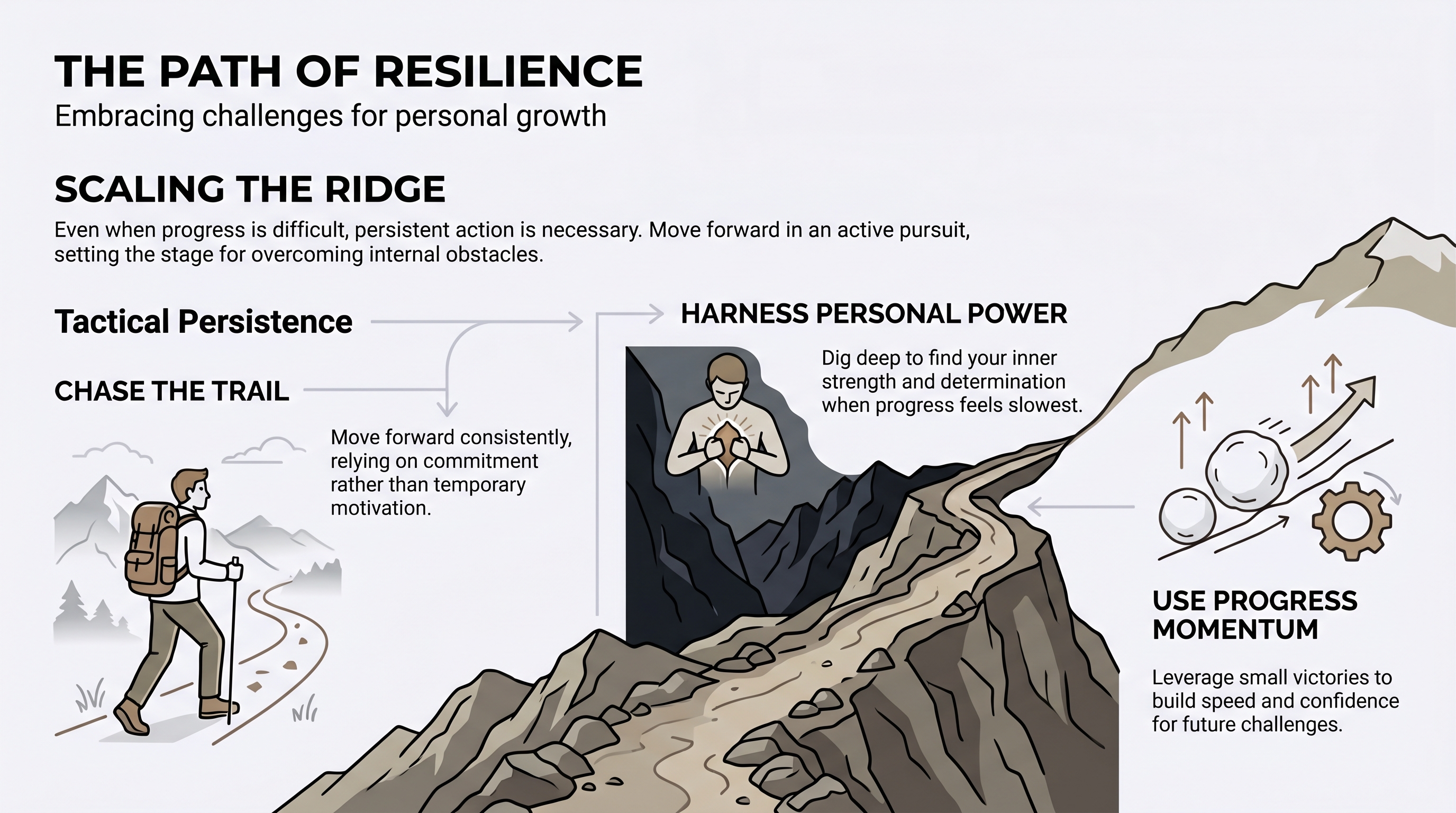
Hillary did not say the mountain doesn't matter. He said the real terrain is inside. Every ridge we are asked to climb — in a career, a relationship, a health journey, a creative pursuit — is ultimately a mirror. The question it asks is always the same: Will you stay on the trail when it gets hard?
Chase the Trail — Not the Feeling
The song's narrator doesn't say they're always certain. They say there's no going back. That distinction is everything. Motivation is a weather system — it comes and goes, rises and falls with your sleep, your hunger, your last conversation. Commitment is a compass. It doesn't fluctuate with your mood.
Tactical persistence — what the song calls "chasing the trail" — means you move forward not because you feel like it, but because you said you would. Thomas Edison endured thousands of failed experiments before finding what worked. He did not succeed because every morning felt inspired. He succeeded because every morning he showed up anyway.
"I have not failed. I've just found 10,000 ways that won't work." — Thomas Edison
Move on commitment, not on temporary motivation. Small, consistent forward motion accumulates into terrain you could never have crossed in a single leap.
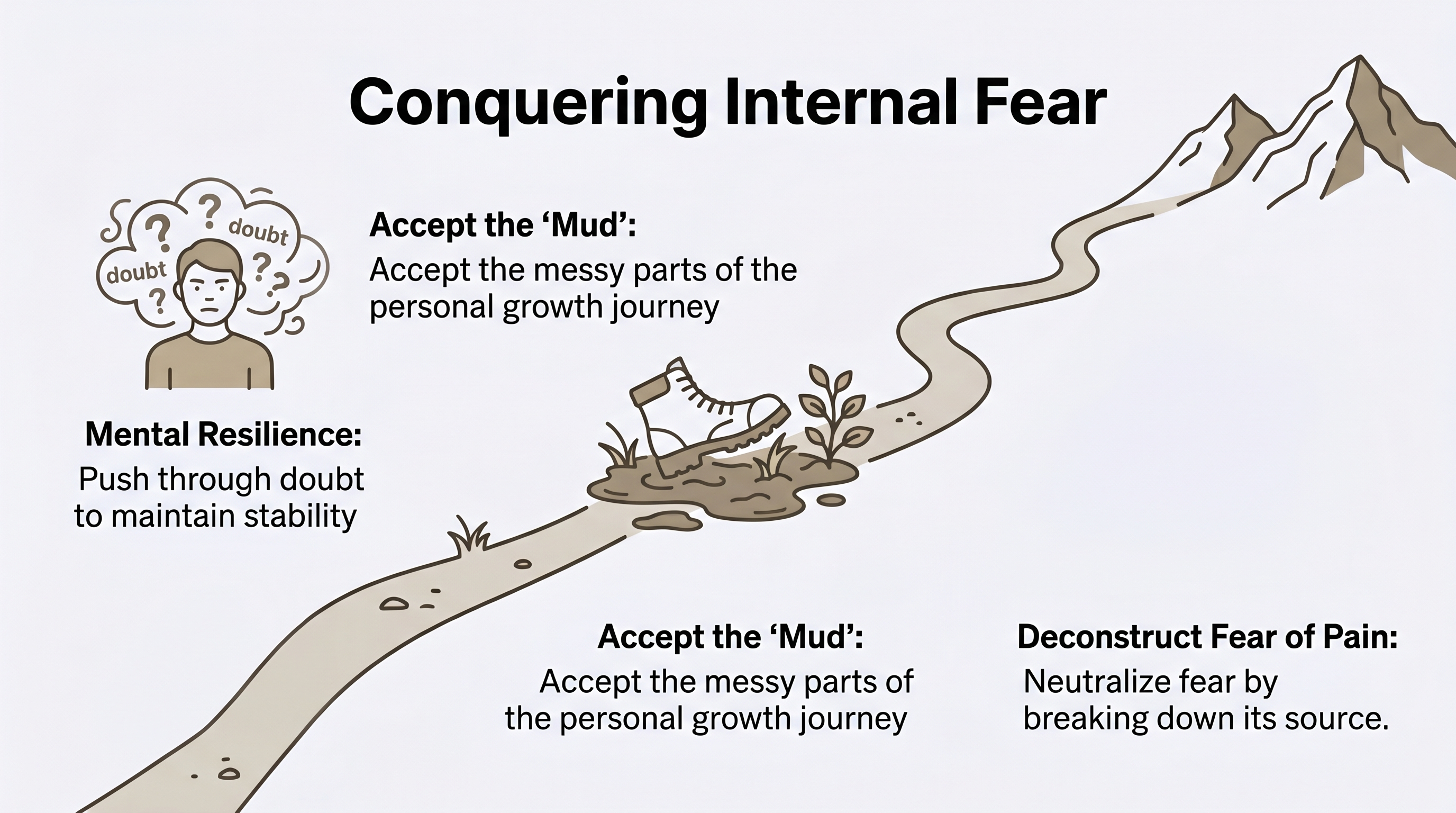
Accept the Mud — All of It
There is a particular kind of suffering that comes not from the hard thing itself, but from our resistance to the fact that it is hard. We suffer twice — once from the difficulty, and once from our shock that difficulty arrived. The song refuses that second suffering. It leans in. It drinks the tailwind like cold champagne. It lets the mud be mud.
Eleanor Roosevelt, who navigated personal loss and public cruelty with extraordinary grace, put it plainly:
"You gain strength, courage, and confidence by every experience in which you really stop to look fear in the face." — Eleanor Roosevelt
Accepting the messy parts of a growth journey is not passive surrender. It is an active, courageous choice to stop spending energy on wishing things were different, and redirect that energy toward moving through what is. The mud does not disappear when you accept it. But it stops being your enemy.
Deconstruct the Fear - Break It Open
No Leavin The Trail Summary
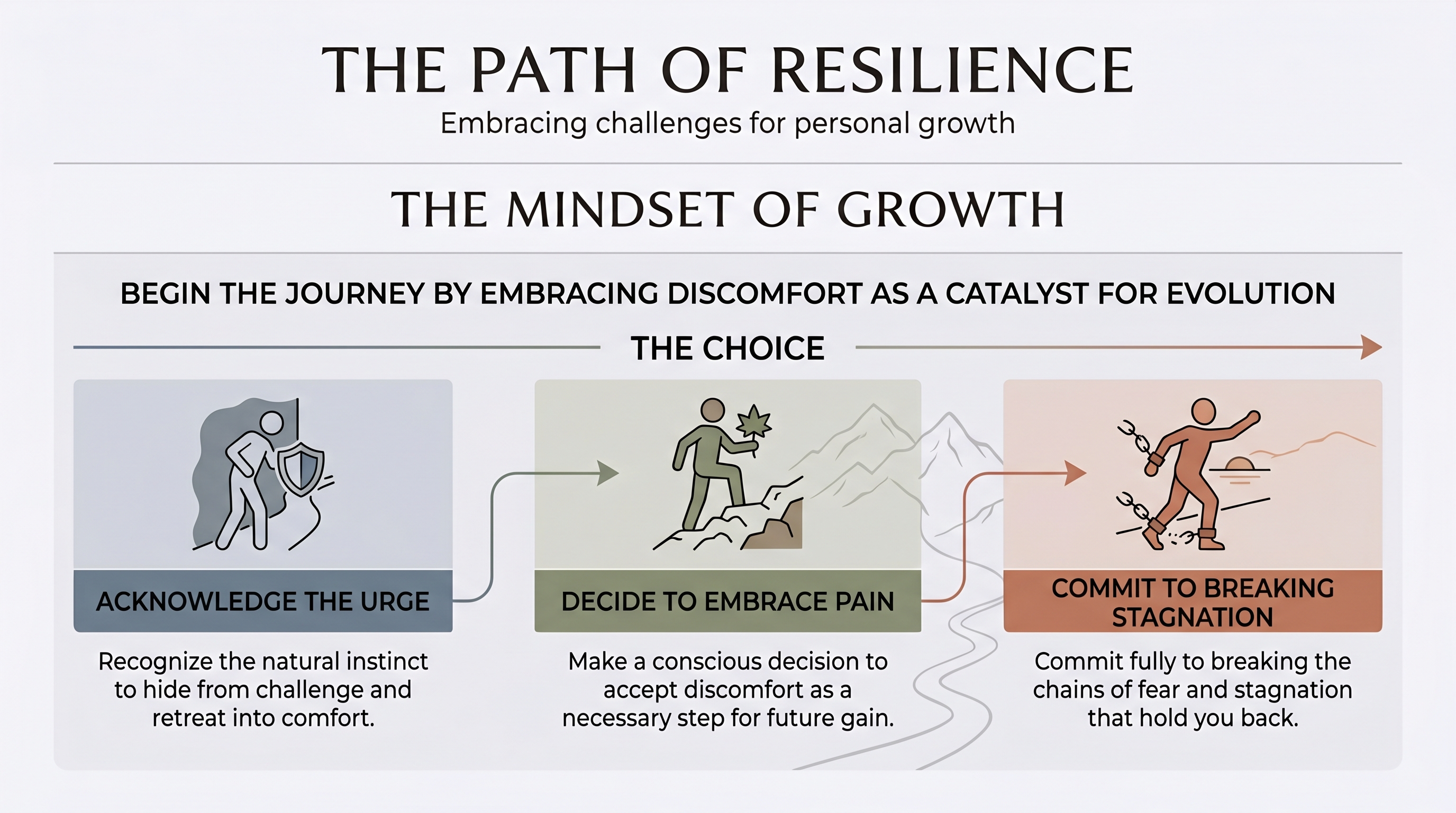
Fear of pain is often worse than pain itself. It is a guardian installed to protect us from harm — but it doesn't always distinguish between genuine danger and the discomfort of growth. The two feel identical from the inside. The song's invitation is to push through doubt and fear together, to name it and walk forward anyway.
Marcus Aurelius, who ruled an empire while managing chronic illness and personal grief, left us one of the most practical formulas for fear ever written:
"The impediment to action advances action. What stands in the way becomes the way." — Marcus Aurelius, Meditations
Deconstructing fear means asking: what, specifically, am I afraid of? When you make fear concrete instead of ambient, it shrinks. A nameless dread fills the whole room. A named fear occupies only its actual dimensions — and then you can walk around it, or through it.
No Leavin The Trail Summary - There Is No Leaving the Trail Tonight
The song's most quietly devastating line is its most simple: There's no leaving the trail tonight. Not "I won't quit." Not "I mustn't." Just — there isn't. The trail and the traveler have become one. The path is no longer something happening to them; it is something they are.
That is what long-haul commitment eventually produces. Not a gritting of teeth, but an identity. You are not someone who is trying to stay on the path. You are the kind of person who doesn't leave it.
Nelson Mandela, who spent 27 years imprisoned and emerged to lead a nation toward reconciliation rather than revenge, said it this way:
"Courage is not the absence of fear — it is the triumph over it. The brave person is not the one who does not feel afraid, but the one who conquers that fear." — Nelson Mandela
Whatever trail you are on today — recovery, reinvention, relationship, vocation, healing — you were not placed on it by accident. The mud underfoot is real. The doubt is real. The midnight ridge is real. And so is your capacity to move through all of it.
You do not have to feel ready. You do not have to feel strong. You only have to take the next step, and then the one after that. Progress is built from exactly those small, unglamorous acts of continuation.
The trail asks only one thing of you: stay on it.
"Don't hide from me — there's no going back. There's no leavin' the trail tonight."