Internal Family Systems And Conscious Parenting
Internal Family Systems And Conscious Parenting
What is IFS?
Developed by psychologist Richard Schwartz in the 1980s, IFS is a therapeutic model built on the idea that the psyche is not a single unified self, but a system of distinct "parts" — each with its own perspective, feelings, memories, and motivations. This isn't pathology; it's considered the natural structure of the mind.The Core Architecture
The Self — the capital-S center of the system. Not a part, but the ground of being. Characterized by what Schwartz calls the 8 C's:
Curiosity, Calm, Clarity, Compassion, Confidence, Creativity, Courage, and Connectedness.
The goal of IFS is not to eliminate parts, but to have the Self lead the system.
What makes IFS especially powerful is how it organizes parts into functional roles rather than labeling them as “good” or “bad.”
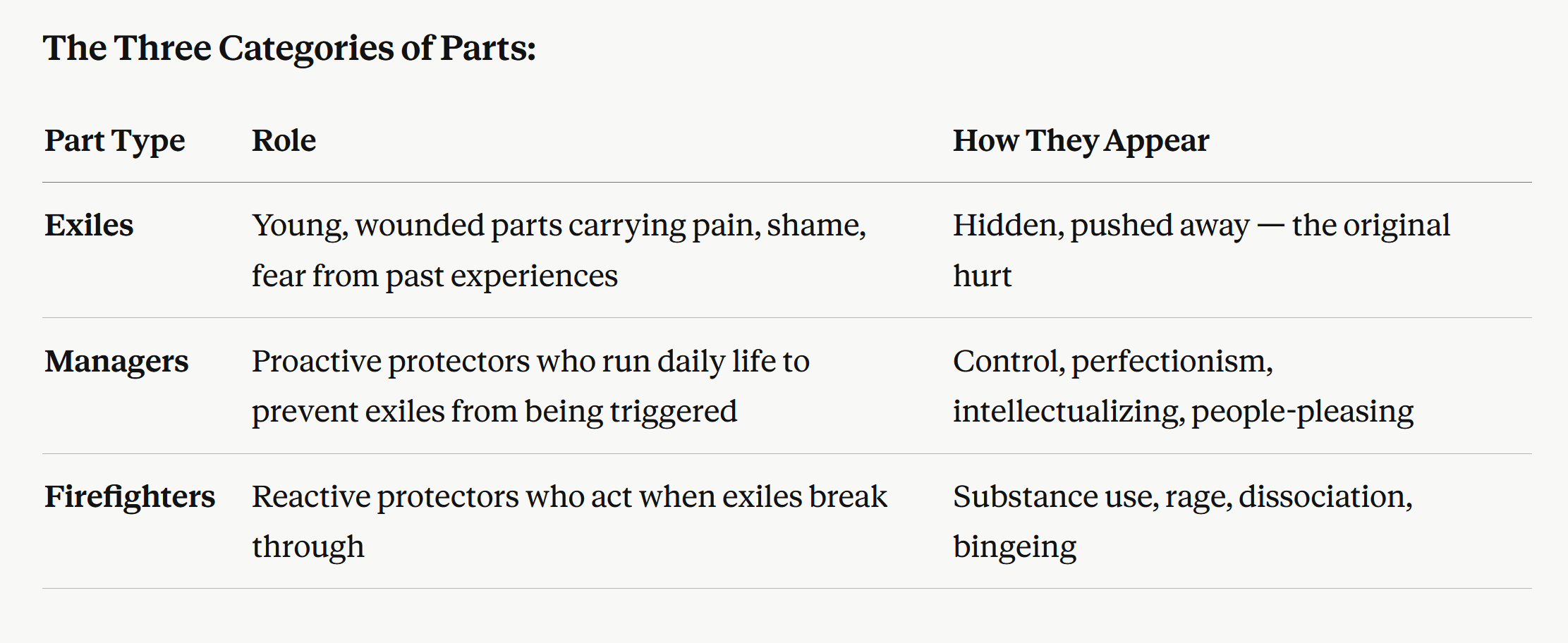
Most parts fall into three broad categories:
Managers are proactive protectors. They try to keep life controlled, predictable, and safe. They show up as perfectionism, people-pleasing, hyper-responsibility, or emotional suppression. Their job is prevention — don’t let anything destabilizing happen.
Firefighters are reactive protectors. When something painful breaks through, they move fast to extinguish it. This can look like anger, numbing, distraction, substance use, shutdown, or impulsive behavior. Their job is immediate relief, not long-term strategy.
Exiles are the younger, vulnerable parts that carry unresolved pain — shame, grief, fear, rejection, or loneliness. They are often pushed out of awareness because their emotions feel overwhelming to the system.
The key shift in IFS is this: every part is trying to help, even when its methods create problems. When approached with curiosity instead of judgment, protectors begin to soften, and exiles can be safely witnessed and unburdened.
Practically, this means learning to slow down internal reactions, build relationships with parts, and consistently return leadership to the Self. Over time, the system becomes less reactive, more flexible, and more aligned — not by force, but through understanding.
The key insight: protectors aren't enemies.
They developed for good reasons and are doing their best with the information they have.
When they feel seen and trusted by the Self, they can relax and allow healing.
Internal Family Systems And Conscious Parenting
How IFS Aligns with Conscious Parenting
At the deepest level, conscious parenting and Internal Family Systems are both non-shaming models of transformation.
Neither begins with “What is wrong with this child?” or “How do I control this behavior?”
They begin with a more courageous question: What is this moment revealing?
Modern developmental research supports this shift.
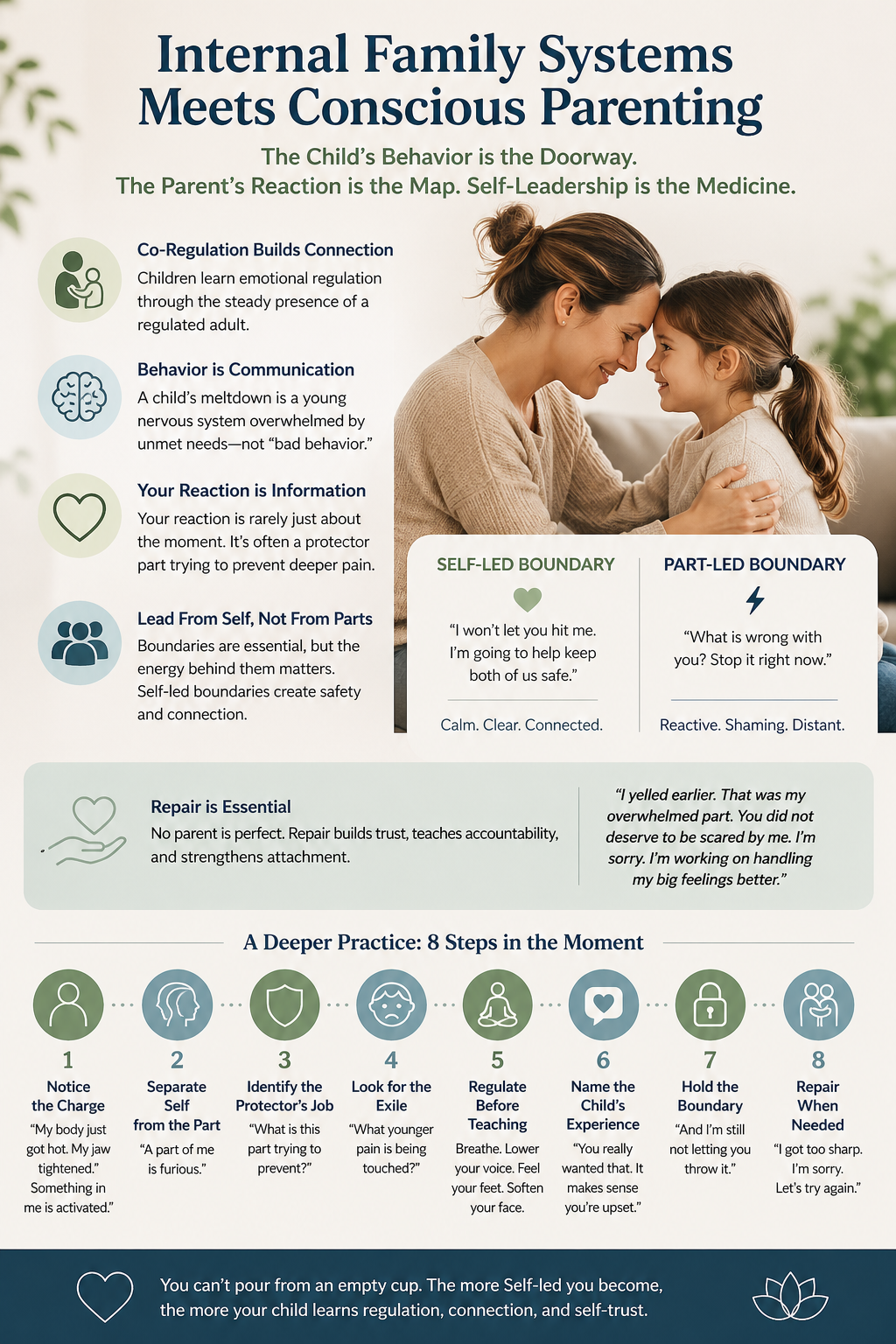
Children learn emotional regulation through co-regulation: the steady presence of a regulated adult helps the child gradually internalize calm, language, and self-control.
In other words, the parent’s nervous system becomes part of the child’s learning environment.
Harvard Health describes co-regulation as connecting with a distressed child and discerning what they need in the moment to calm and organize themselves. (Harvard Health)
This is where IFS adds precision. A child’s meltdown is rarely “bad behavior” in the moral sense.
It is often a young nervous system overwhelmed by fear, shame, hunger, fatigue, disappointment, sensory overload, or unmet attachment needs.
Likewise, the parent’s reaction is rarely just “anger.”
It may be a protector part trying to prevent embarrassment, danger, disrespect, chaos, or helplessness.
So the practical question becomes:
Which part of me is meeting which part of my child?
A child’s defiant part may activate a parent’s controlling manager.
A child’s sadness may activate a parent’s fixer.
A child’s disrespect may activate a parent’s shamed exile.
A child’s neediness may activate a parent’s exhausted avoidant protector.
This is why conscious parenting is not permissive parenting.
It is not “let the child do whatever they want.” It is regulated leadership without domination. The parent still sets boundaries, but the boundary comes from Self rather than from panic, ego, revenge, or humiliation.
A Self-led boundary sounds like:
“I won’t let you hit me. I’m going to help keep both of us safe.”
A part-led boundary sounds like:
“What is wrong with you? Stop it right now.”
The behavior limit may be the same. The energy is completely different.
IFS also helps parents repair after rupture.
Repair is essential because no parent remains Self-led all the time.
The goal is not perfection.
The goal is recovery, honesty, and reconnection.
Child development experts consistently emphasize that warm, responsive caregiving supports secure attachment and emotional development. (American Academy of Pediatrics)
A repair might sound like:
“I yelled earlier. That was my overwhelmed part. You did not deserve to be scared by me. I’m sorry. I’m working on handling my big feelings better.”
That one sentence teaches accountability, emotional literacy, humility, and safety.
A Deeper Practice for Internal Family Systems And Conscious Parenting
In the moment, use this sequence:
1. Notice the charge.
“My body just got hot. My jaw tightened. Something in me is activated.”
2. Separate Self from the part.
Instead of “I am furious,” say: “A part of me is furious.”
3. Identify the protector’s job.
“What is this part trying to prevent? Embarrassment? Loss of control? Being disrespected?”
4. Look for the exile underneath.
“What younger pain is being touched? When did I learn that mess, anger, need, or defiance was unsafe?”
5. Regulate before teaching.
Breathe. Lower your voice. Feel your feet. Soften your face. Your child learns more from your nervous system than your lecture.
6. Name the child’s experience.
“You really wanted that. It makes sense you’re upset.”
7. Hold the boundary.
“And I’m still not letting you throw it.”
8. Repair when needed.
“I got too sharp. I’m sorry. Let’s try again.”
The integrated principle in Internal Family Systems And Conscious Parenting is this:
The child’s behavior is the doorway.
The parent’s reaction is the map.
Self-leadership is the medicine.
Your second block of text...